
Competitive Edge Through It Security Readiness

As defence spending, preparedness priorities and critical supply-chain requirements increase, industrial and technology suppliers need to prove that they can handle sensitive information, collaborate securely and deliver reliably.
A growth environment
Defence and preparedness are moving higher on the agenda. For companies in industrial, technology and critical supply chains, this creates new opportunities, but also higher expectations on security requirements related to reliability, traceability and information control.
IT security becomes a commercial qualifier
Security requirements are no longer only administrative barriers. In security-sensitive value chains, they are a qualification criteria. The question is not only how to comply, but also how to rapidly scale, leverage and excel within the domain to remain competitive and attractive for customers, contracts and partnerships.
“The question is shifting from whether an actor or partner can deliver, to whether they can deliver securely and under scrutiny.”
Establishing secure collaboration is key
Access control, data classification, secure file sharing, system resilience and supplier connectivity are all examples of functions and services that determine whether companies can collaborate efficiently in sensitive environments. Without these capabilities, companies often rely on manual inefficient workarounds and unclear information-sharing rules.
Core dimensions impacting IT security readiness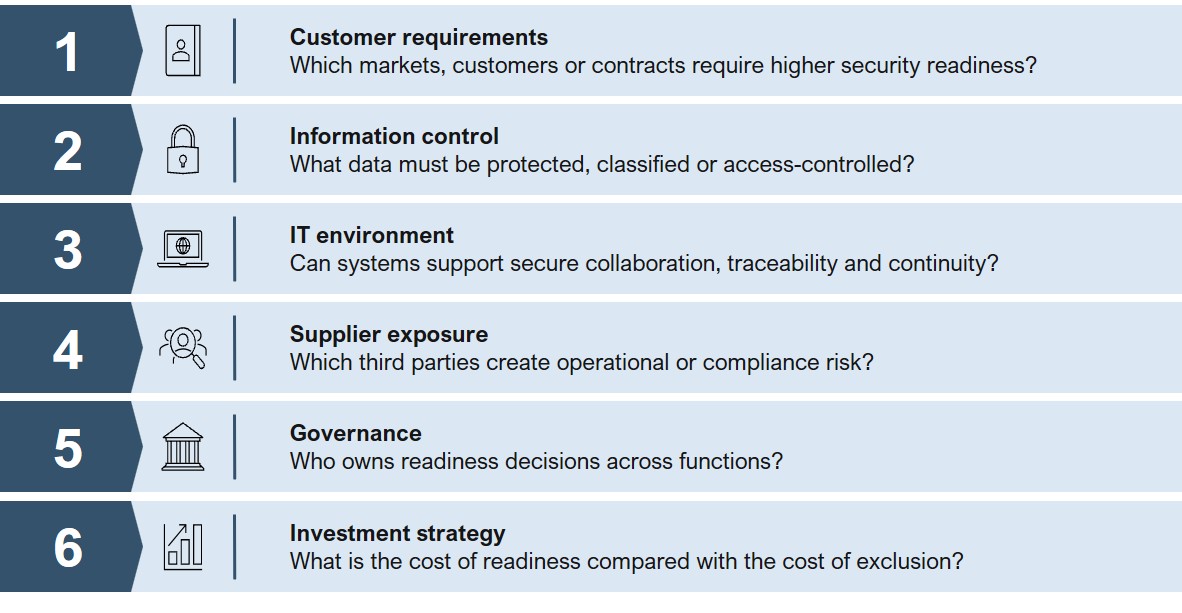
IT security readiness requires clear ownership
To ensure IT security readiness, multiple dimensions need to be considered, both across the internal organisation as well as vertically in the value chain. Without clear ownership and structure, the risk of failure increase as companies often treat IT security readiness as isolated compliance task, rather than a critical business capability.
The cost of exclusion
Readiness requires both efforts and investments, but being unprepared could carry an even higher price tag. Companies that cannot meet security expectations risk losing access to attractive markets, business opportunities and in the long run, their competitive edge.
